


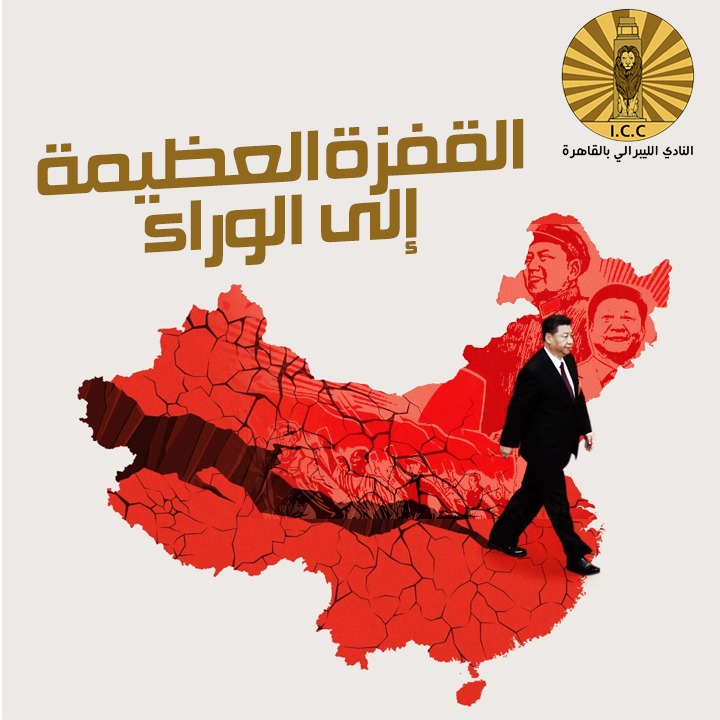
On October 1, 1949, the Chinese leader “Mao Zedong” announced the establishment of the People’s Republic of China, and he became the first president of the Republic of China until 1959. Mao approached Stalin, considering that the Soviet Union shared the communist ideology, and since “Mao” and his companions had no experience In political administration, the Soviet Union provided them with the communist model available for state administration, so a five-year plan was drawn up under the guidance of the Soviet Union, which entered into force in 1953 and included Soviet technical assistance in a number of industrial facilities, agricultural reform initiatives, agricultural cooperatives, and the expansion of health services, etc., and in the year 1958 “Mao” launched the “Great Leap Forward” initiative, which was the most ambitious five-year plan (1958-1962), with the aim of developing industry in China in parallel with agriculture, in order to surpass the achievements of the West and present a new “Chinese” model of communism. The result was disastrous, as Mao’s policies led to a massive decline. In agricultural production, China entered a famine that resulted in deaths estimated at about 30 million people.
Mao’s great leap forward ended in a disaster for which the Chinese people paid the price, facing death from famine. Those who managed to survive it lived a life of extreme poverty without food and in shabby clothes. Mao was eventually forced to buy wheat from capitalist countries to feed his people.
The matter did not end there, and after Mao was forced to resign while maintaining his position as General Secretary of the Party, many local officials were tried and executed in front of the public. China then began a series of economic reforms, which later led it to be one of the strongest economies in the world. He even launched It has the nickname “the world’s factory” as it is responsible for about 30% of global manufacturing output. But thanks to Xi’s policies, it was unable to produce new jobs.
Amid the severe economic crisis in China and the economic war with the United States, nearly 20% of young people in China suffer from unemployment, and one study indicates that out of 11 million Chinese students who graduated this year from their colleges, only 15% of them were able to get jobs. They receive wages 12% less than the class of 2021, meaning that many of them did not earn more than the salary of truck drivers, but they were lucky to have found a job.
But it seems that Chinese President Xi Jinping is not as busy reforming or reversing those policies that led to his country’s financial collapse as he is busy extending his position as General Secretary of the Chinese Communist Party at the upcoming twentieth party congress, which is only a few weeks away.
China, like other countries, faced during its reign periods of boom and bust in employment, but temporary policies, such as sending graduates to work in the countryside, could not solve the employment crisis, but rather take us back to the “Great Leap Forward,” which was one of the goals of “Mao’s” initiative. To solve the problem of urban unemployment, tens of millions of young people were forcibly resettled from crowded Chinese cities to the countryside. It was called “downward-sampling,” not only because the jobs available in the cities were only enough for half of the young graduates, but also for political considerations to disperse ideologically undesirable groups. Throughout the country, young Chinese were separated from their families and linked to the party, and this campaign ended in a series of massive popular protests that led to its end in 1980.
Later, in June 1962, the Communist Party described Mao’s policies as “disastrous.” Despite this, we find Xi repeating those policies again in a “great leap,” but this time “backwards.” He announced programs to encourage urban students to travel to the countryside, The Chinese Communist Party has decreed subsidies, government-backed loans and tax incentives for university graduates to start businesses in the countryside, at least not forced resettlement – as Mao did – yet.
In fact, in another echo of the Mao era, Xi hoped that urbanization policies, debt-backed spending on infrastructure projects, and giant structural reforms would close the job gap created by decades of reforms in the educational system in response to political necessity rather than need. And market requirements, as these reforms followed the Tiananmen massacre in 1989 by promising an affordable university education system, then codifying a long-term program to expand university enrollment to stimulate the Chinese economy. But here we must remember that China’s central planning system is unable to create, employ and retain the best talent.
The economic crisis that China is suffering from these days is different from the economic crisis in 2008. There are increasing indications that the Chinese population has reached a critical point. Last July, violent protests were reported outside a number of Chinese banks after citizens’ accounts were frozen without explanation, and in 24 provinces. Out of 31 Chinese provinces, families have stopped making mortgage payments due to late dates for receiving new apartments, in addition to the cases of wealthy Chinese fleeing outside Chinese territory. All of this demonstrates the state of weak trust between the Chinese people and the Chinese Communist Party, which is still continuing to erode.
Under these circumstances, will Xi pull a rabbit out of his political hat at the next Chinese Communist Party meeting? Or will the party overthrow him, as happened with the person who made the first leap?!
Will Xi complete his “Great Leap Back” and follow Mao’s approach in deepening the influence of the party-state in the daily lives of China’s citizens? Will Xi order massive, expensive, and unproductive recruitment drives through state-owned enterprises or channel hundreds of thousands of workers into the military-industrial complex? Will he work to repair relations with the European Union as a way out of the crisis, despite China’s support for Russia’s invasion of Ukraine? Finally, will the “Great Leap Back” policies work to calm Chinese youth?